
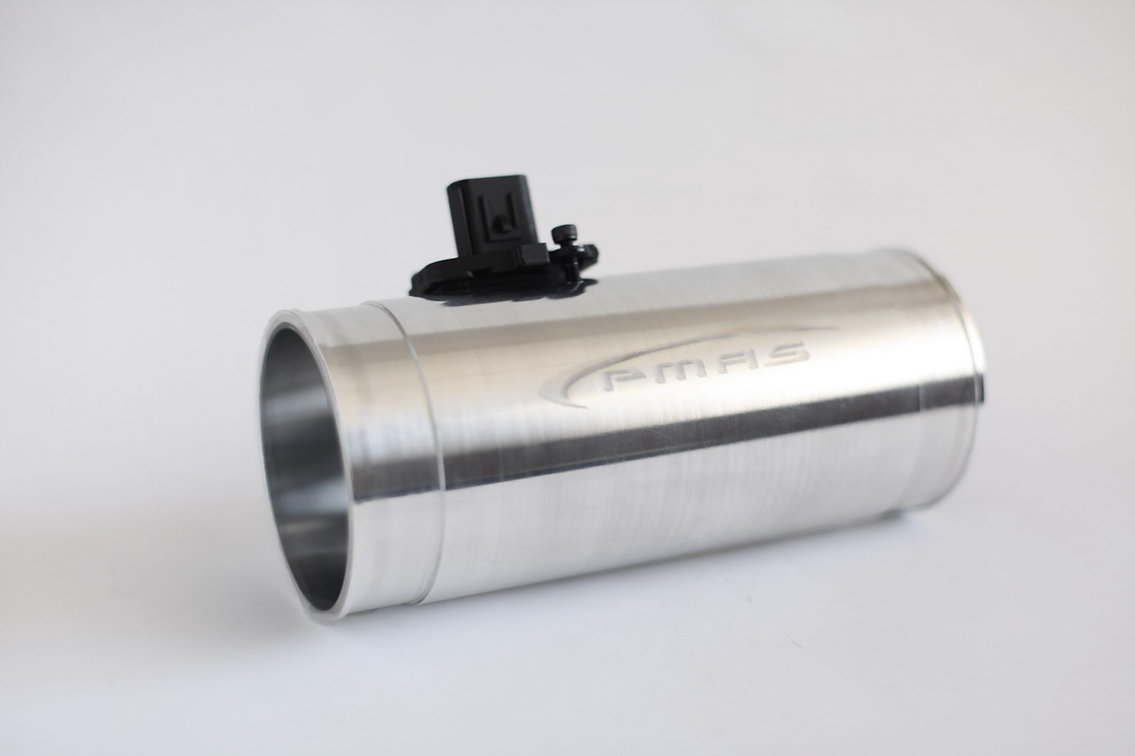
We have appropriated the HPX sensor for every boosted application we can. From draw-through turbo to blow-through supercharger (both of these are nonstandard), to the conventional blow-through turbo and draw-through supercharger configurations.

We like the HPX, our scaling works well. It’s based off of figures provided by PMAS. The failure rate for these seems low: none of the cars operating with our software with this maf have reported maf failures as of time of publishing. The metal housing can be welded. It reads a lot of power. The wiring for it is a simple harness that we offer. The MH-30 housing is a natural fit for most m5x setups, which will reasonably run a 3″ cold side charge pipe. But this maf is flexible in that it can be put in a larger housing and it’s viable to scale the maf to read more air.
Also, should you want to do the wiring yourself: on the chassis side: pin 1 is ground, pin 2 is signal and pin 3 is 12+. On the maf side: pin 3 is signal, pin 4 is local ground, pin 5 is harness/dme ground, pin 6 is 12+.
I like to wire up the local ground to the chassis, but plenty of people have success twisting the ground together and sending back to the dme.
We have only had one maf failure with the Bosch Audi maf. But abuse was involved, I don’t blame the maf. The plastic housing is more robust than the factory e46 mafs, and thus the Audi maf doesn’t fail as easily as factory e46 mafs. But they’re both 3.5″ and fit poorly in what should usually be a simple 3″ charge pipe from intercooler to throttle body. This works well for some draw-through intended supercharger kits made for use with the stock 3.5″ maf as part of the precharger filter pipe. Getting the 5v signal for pin 4 is one of the complications of this maf.

This maf is Bosch part number 0 280 218 067 or 0 986 280 219
on the chassis side pin 1 is ground, pin 2 is signal and pin 3 is 12v+.
For the Bosch maf: pin 2 is 12v+, pin 3 is ground, pin 4 is 5v signal, pin 5 is
the maf signal
Conclusion: They both work and should be used in applications that make fitment pleasant. Turbo cars should probably run HPX sensors with MH-30 housings. If you’re game to source a 5v signal and like the 3.5″ paradigm that mimics the factory design, but is much longer, the Bosch maf might be a great fit for you.

